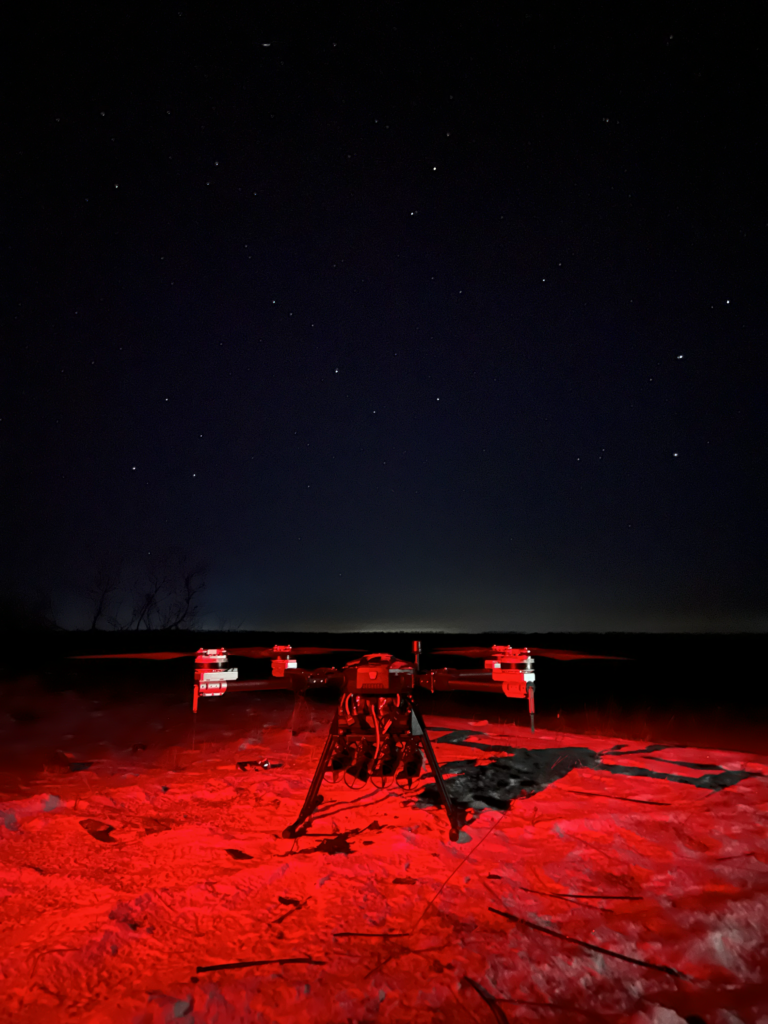
During the day, the sky belongs to everyone. At night, the sky belongs to the professionals.
Most basic drone operator courses teach you to pilot by “sight”: you see the horizon, landmarks, trees. But real war doesn’t stop at sunset. On the contrary, the most critical enemy logistical movements, rotations, and assault attempts happen under the cover of darkness.
An operator who can only fly during the day is only “half” an operator. At HTEC “MIST”, we train pilots capable of being effective 24/7.
Why is Night the Time for “Heavy Birds”?
Heavy strike multirotors like the Pegasus Arms 25 are often called “nightmares” or “Baba Yaga” (in enemy terminology). Their element is darkness.
- Thermal Vision: At night, camouflage doesn’t work. A warm tank engine, a heated gun barrel, or an infantryman’s body heat in a tree line glows on the operator’s screen like a Christmas tree.
- Element of Surprise: The enemy hears the sound but cannot visually spot the drone. This sows panic and demoralizes.
- Crew Safety: At night, it is easier for the operator to mask their takeoff and landing position.
The Difficulty No One Talks About
So why doesn’t everyone fly at night? Because it is difficult and dangerous for the equipment.
At night, the pilot loses visual references. The sense of horizon, altitude, and speed disappears. The brain can play cruel tricks, making you think the drone is flying level when it is actually entering a fatal dive. This is called spatial disorientation.
To fly at night, you must be able to pilot “by instruments” (telemetry) and navigate exclusively using thermal imaging, which differs significantly from a standard camera feed.
Training at HTEC “MIST”: 10 Hours of Practice in the Dark
We don’t just teach theory about night ops. We take you out into the field when the sun goes down.
The “PEGASUS ARMS 25” course includes an unprecedented 10 hours of night flights. This is one of the most intensive programs available in Ukraine.
What You Will Learn:
- Navigation: How to build a route when tree lines and roads are invisible.
- Thermal Imaging Mastery: How to distinguish a sun-heated rock from a camouflaged enemy.
- Precision Drops: The specifics of aiming at night (altitude, wind correction without visual cues).
- Landing: The hardest part. How to land a heavy aircraft in total darkness without revealing your position with light.
Become a night hunter, not the prey.
👉 Enroll in the Night Operations Course: UAV Operator Course PEGASUS ARMS 25